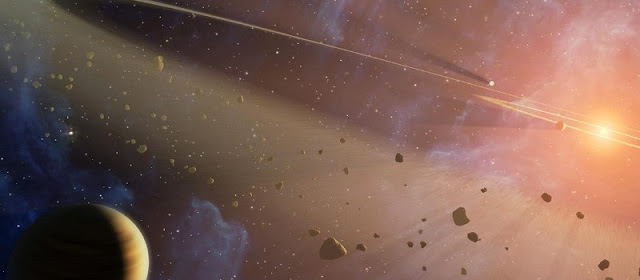
Conspiracy theorists alike have long suspected that there might be ninth planet in our Solar System, far out beyond the orbit of Pluto.
'Planet X' community has occasionally suggested that this distant ninth world is currently on a devastating collision course with our own planet. But actual scientists are interested in the idea too, mainly because of the need to explain anomalies in the orbits of extremely far-off objects in the Kuiper Belt, the vast and mysterious disc of rock, ice and comets that extends beyond the orbit of Neptune.

Most recently Scott Sheppard from the Carnegie Institution for Science, and Chad Trujillo, from the Gemini Observatory in Hawaii, argued in a 2014 paper and subsequent research that several small objects, including 2012 VP113 and a 500-1,000 km across rock called V774104, exhibit a strange discrepancy in their orbits. Specifically, there is a strange gap between their closest approach to the Sun and the time when they pass through the 'plane' of the Solar System. This discrepancy could have several causes -- other researchers have argued it might be the result of 'stellar nurseries' near to our Solar System, or an object pulled out of orbit from its star and into the outer reaches of our own -- but a large, dark planet, estranged but still at home around our sun, was considered a more likely cause. Now a team at the California Institute of Technology believe they have found clear evidence of that giant, icy world -- our Sun's ninth -- orbiting at an almost unimaginably vast distance.

The paper, published by Konstantin Batygin and Mike Brown -- the latter of whom, in a neat twist, was one of the researchers primarily responsible for demoting Pluto to a dwarf planet in 2006 -- in the Astronomical Journal, describes this world as being five to 10 times as massive as Earth and around two to four times as wide. That scale is not closely matched by any existing world, but would make the planet the fifth largest in the Solar System, closest in mass to Uranus.
The existence of almost-planets in the belt is nothing new on its own -- Pluto was long regarded as a 'Planet X' itself, before it was discovered, finally, in 1930 (and until its demotion to a dwarf planet in 2006). Make-make and Haumea are two further dwarf planets that lie in the belt, while Eris is more massive even than Pluto and usually orbits the Sun from a much greater distance. But all of these objects are orders of magnitude smaller than Planet Nine.
The orbit of Planet Nine is extreme, never coming closer than 30.5 kilometres from the Sun, which is five times further than the average orbit of Pluto. The world would be extremely cold and dark -- which is why no one has ever taken a direct picture of it. Indeed, so controversial is the planet that Batygin and Brown initially launched their investigation to prove Planet Nine did not exist, and disprove the 2014 paper by Sheppard and Trujillo. But after building on research by other astronomers, Brown and Batygin found their computer model of the object's orbits only worked if Planet Nine existed; the "clustering" of the objects was only possible if a ninth planet was affecting their orbits, twisting them by up to 90 degrees and keeping them from coming as close as expected to the Sun.
"It's almost like having six hands on a clock all moving at different rates, and when you happen to look up, they're all in exactly the same place," Brown said in a statement. "Basically it shouldn't happen randomly." "Shouldn't something like that be hard to miss?" Brown told Scientific American. "Yes, you would think so. This a case where we had our noses buried in the data, never stepping back and looking at the Solar System from above. I couldn't believe I'd never noticed this before. It's ridiculous."
Brown and Batygin said they had considered the possibility that instead of a planet, an object had formed more recently in the belt comprised of comets and rocky balls clumped together. On review that appears to be impossible, because the belt does not contain enough mass. A planet roughly five times as massive as Earth, however, formed along with the rest of the Solar System, perfectly fits the model, and explains other strange phenomena discovered in the belt in recent decades.
"Continued analysis of both distant and highly inclined outer Solar System objects provides the opportunity for testing our hypothesis as well as further con-straining the orbital elements and mass of the distant planet," the paper says.
Most recently Scott Sheppard from the Carnegie Institution for Science, and Chad Trujillo, from the Gemini Observatory in Hawaii, argued in a 2014 paper and subsequent research that several small objects, including 2012 VP113 and a 500-1,000 km across rock called V774104, exhibit a strange discrepancy in their orbits. Specifically, there is a strange gap between their closest approach to the Sun and the time when they pass through the 'plane' of the Solar System. This discrepancy could have several causes -- other researchers have argued it might be the result of 'stellar nurseries' near to our Solar System, or an object pulled out of orbit from its star and into the outer reaches of our own -- but a large, dark planet, estranged but still at home around our sun, was considered a more likely cause. Now a team at the California Institute of Technology believe they have found clear evidence of that giant, icy world -- our Sun's ninth -- orbiting at an almost unimaginably vast distance.
The paper, published by Konstantin Batygin and Mike Brown -- the latter of whom, in a neat twist, was one of the researchers primarily responsible for demoting Pluto to a dwarf planet in 2006 -- in the Astronomical Journal, describes this world as being five to 10 times as massive as Earth and around two to four times as wide. That scale is not closely matched by any existing world, but would make the planet the fifth largest in the Solar System, closest in mass to Uranus.
The existence of almost-planets in the belt is nothing new on its own -- Pluto was long regarded as a 'Planet X' itself, before it was discovered, finally, in 1930 (and until its demotion to a dwarf planet in 2006). Make-make and Haumea are two further dwarf planets that lie in the belt, while Eris is more massive even than Pluto and usually orbits the Sun from a much greater distance. But all of these objects are orders of magnitude smaller than Planet Nine.
The orbit of Planet Nine is extreme, never coming closer than 30.5 kilometres from the Sun, which is five times further than the average orbit of Pluto. The world would be extremely cold and dark -- which is why no one has ever taken a direct picture of it. Indeed, so controversial is the planet that Batygin and Brown initially launched their investigation to prove Planet Nine did not exist, and disprove the 2014 paper by Sheppard and Trujillo. But after building on research by other astronomers, Brown and Batygin found their computer model of the object's orbits only worked if Planet Nine existed; the "clustering" of the objects was only possible if a ninth planet was affecting their orbits, twisting them by up to 90 degrees and keeping them from coming as close as expected to the Sun.
"It's almost like having six hands on a clock all moving at different rates, and when you happen to look up, they're all in exactly the same place," Brown said in a statement. "Basically it shouldn't happen randomly." "Shouldn't something like that be hard to miss?" Brown told Scientific American. "Yes, you would think so. This a case where we had our noses buried in the data, never stepping back and looking at the Solar System from above. I couldn't believe I'd never noticed this before. It's ridiculous."
Brown and Batygin said they had considered the possibility that instead of a planet, an object had formed more recently in the belt comprised of comets and rocky balls clumped together. On review that appears to be impossible, because the belt does not contain enough mass. A planet roughly five times as massive as Earth, however, formed along with the rest of the Solar System, perfectly fits the model, and explains other strange phenomena discovered in the belt in recent decades.
"Continued analysis of both distant and highly inclined outer Solar System objects provides the opportunity for testing our hypothesis as well as further con-straining the orbital elements and mass of the distant planet," the paper says.